When Antarctica’s “Brakes” Fail: How Ocean Warming Threatens Ice Shelves
I’m excited to share a new study led by Clara Burgard and published in Nature in November 2025, and to which I contributed to as a co-author. In this study, we explore a critical question for the future of Antarctica and its potential contribution to sea level rise: how stable are Antarctic ice shelves in a warming world?
🧊 What are ice shelves, and why do they matter?
Ice shelves are the floating extensions of the Antarctic ice sheet. They might look passive, but they play a crucial role: they act like giant buttresses, slowing down the flow of land-based ice into the ocean.
You can think of them as the brakes of Antarctica. As long as they are intact, they hold back glaciers upstream. But if they weaken or disappear, those glaciers can accelerate—leading to increased sea-level rise.
🌡️ Looking beyond the atmosphere
Most previous studies have focused on how warming air temperatures affect ice shelves—through surface melting, for example.
In this work, we take a more complete approach:
What happens when we consider both atmospheric warming and ocean warming together?
📊 What we found
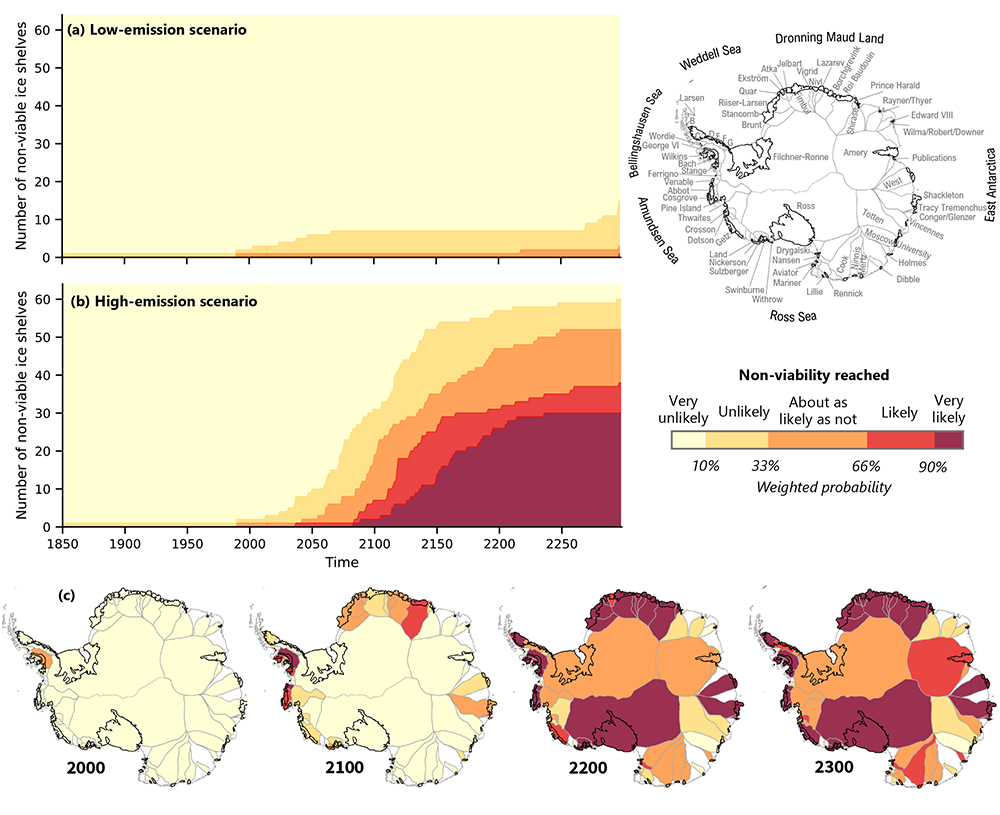
Our results show a stark contrast depending on how much the planet warms:
If global warming stays below ~2°C
- Almost all Antarctic ice shelves remain viable for centuries
- Only 1 out of 64 becomes likely unstable by 2300
If warming reaches very high levels (~12°C by 2300)
- Ice shelves start becoming unstable once warming exceeds ~4.5°C
- By 2150: 26 ice shelves likely non-viable
- By 2300: 38 ice shelves likely non-viable
👉 The main driver: ocean-induced melting
🌍 Why this matters
The ice shelves that could become non-viable are not small or isolated. Together, they restrain parts of the Antarctic ice sheet that contain enough ice to raise global sea level by up to 10 meters.
This does not mean such sea-level rise will happen quickly—but it highlights the long-term commitment associated with continued warming.
⚠️ A conservative estimate
Our results estimate when ice shelves become non-viable—when they can no longer maintain their present-day structure.
However, collapse could occur earlier, especially due to processes like:
- Surface meltwater weakening the ice (hydrofracturing)
- Structural instabilities not fully captured in large-scale models
These estimates should therefore be seen as upper bounds.
🔍 The bigger picture
This study reinforces a key message:
The future of Antarctica—and global sea level—depends strongly on how much we warm the planet.
Keeping warming low doesn’t just slow changes, it can determine whether most ice shelves remain intact or a large fraction is lost.